
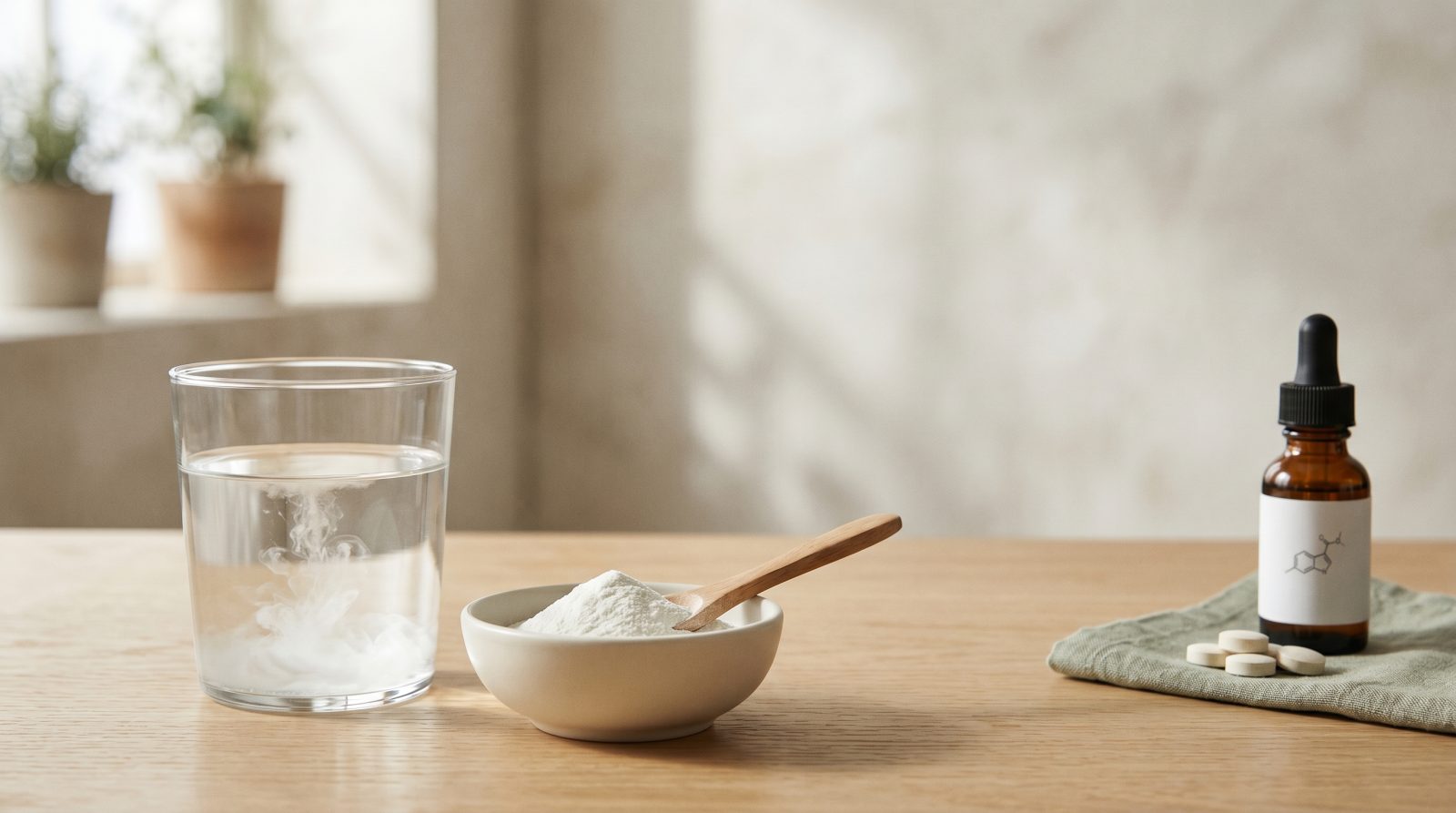
Cyclodextrins are ring-shaped sugar molecules that can encapsulate CBD molecules within their hydrophobic interior. This creates a water-soluble complex used in CBD powders, dissolving tablets, and pharmaceutical applications. Cyclodextrin-based CBD has different properties than nanoemulsion or liposomal alternatives. The complex behaves less like an oil and more like a pharmaceutical excipient, which is why precise-dose formats favour it.
What cyclodextrins are
Cyclodextrins are oligosaccharides produced by enzymatic conversion of starch. They have a distinctive ring structure with:
- A hydrophobic (water-fearing) interior cavity
- A hydrophilic (water-loving) exterior
- The ability to insert small molecules into their cavity
Three main types are used in pharmaceutical and food applications:
- Alpha-cyclodextrin (α-CD): 6-sugar ring, smallest cavity
- Beta-cyclodextrin (β-CD): 7-sugar ring, mid-sized cavity (most common for CBD)
- Gamma-cyclodextrin (γ-CD): 8-sugar ring, largest cavity
How CBD-cyclodextrin complexation works
The process creates a stable inclusion complex:
- Cyclodextrin is dissolved in water (it is naturally water-soluble)
- CBD molecules (which are hydrophobic and oil-soluble) are introduced
- The CBD molecules migrate into the cavity of the cyclodextrin
- The cyclodextrin's hydrophilic exterior carries the CBD-containing complex into solution
- The complex behaves as water-soluble in subsequent applications
Advantages of cyclodextrin-based CBD
- Stable solid form: Can be freeze-dried into powders for shelf stability
- Long shelf life: The complex is stable for extended periods
- Pharmaceutical-grade: Cyclodextrins are well-characterized excipients with extensive safety data
- Predictable bioavailability: The complex releases CBD reliably in digestive conditions
- Suitable for tablets, powders, and capsules
- Often regulated in pharmaceutical/food contexts as established ingredient
Disadvantages of cyclodextrin-based CBD
- Cost: Cyclodextrins add cost vs nanoemulsion approaches
- Loading capacity: A specific amount of cyclodextrin holds a specific amount of CBD, requiring more material for higher doses
- Bioavailability not always highest: Sometimes lower than nanoemulsion-based water-soluble CBD
- Taste: Some cyclodextrins have a slight taste affecting product formulation
- Limited consumer recognition: Less marketing buzz than nanoemulsion
Where cyclodextrin-based CBD is used
Dissolving tablets and powders
Cyclodextrin's stable solid form suits dissolvable products:
- Effervescent tablets that dissolve in water
- Single-serve powder sachets
- Powdered beverage formulations
- Capsules with rapid disintegration
Pharmaceutical applications
The pharmaceutical industry uses cyclodextrins for many drug formulations. CBD-cyclodextrin complexes appear in:
- Prescription CBD formulations
- Research-grade CBD products
- Some over-the-counter products in specific regulatory frameworks
Long-shelf-life consumer products
Cyclodextrin-based CBD is favoured where:
- Long shelf life without refrigeration is required
- Solid form is needed (tablets, powders)
- Stable performance over months is essential
- Production scale benefits from inclusion complex chemistry
Cyclodextrin vs nanoemulsion vs liposomal CBD
| Property | Cyclodextrin | Nanoemulsion | Liposomal |
|---|---|---|---|
| Physical form | Powder or solution | Solution | Solution |
| Bioavailability | Improved over oil | Highest typically | Variable |
| Onset time | 15-45 minutes | 10-30 minutes | 15-45 minutes |
| Stability | Excellent (months) | Good (6-12 months) | Moderate (6-9 months) |
| Production cost | Higher | Lower | Higher |
| Best for | Tablets, powders, pharmaceuticals | Beverages | Premium oral CBD |
Safety considerations
Cyclodextrins are generally regarded as safe (GRAS by FDA, approved as food additives in many jurisdictions):
- Beta-cyclodextrin has been used as a food ingredient for decades
- Excellent safety profile in oral use
- Not absorbed in significant amounts (passes through digestive tract)
- Some can affect cholesterol absorption (clinically irrelevant in typical amounts)
Reading product labels
Products using cyclodextrin-based CBD may list:
- "Beta-cyclodextrin" or "β-cyclodextrin" in ingredients
- "CBD-cyclodextrin complex"
- "CBD inclusion complex"
- Specific cyclodextrin names (CD-α, CD-β, CD-γ)
The form of CBD delivery is sometimes prominently advertised, sometimes only in the ingredient list. Look in both places.
The future of cyclodextrin-based CBD
Cyclodextrin technology continues to develop:
- Modified cyclodextrins with improved performance
- Better loading capacity (more CBD per cyclodextrin)
- Reduced cost through manufacturing scale
- Specific applications targeting controlled release
For consumers, cyclodextrin-based CBD products tend to be premium offerings with excellent shelf stability, useful when those properties matter most.