
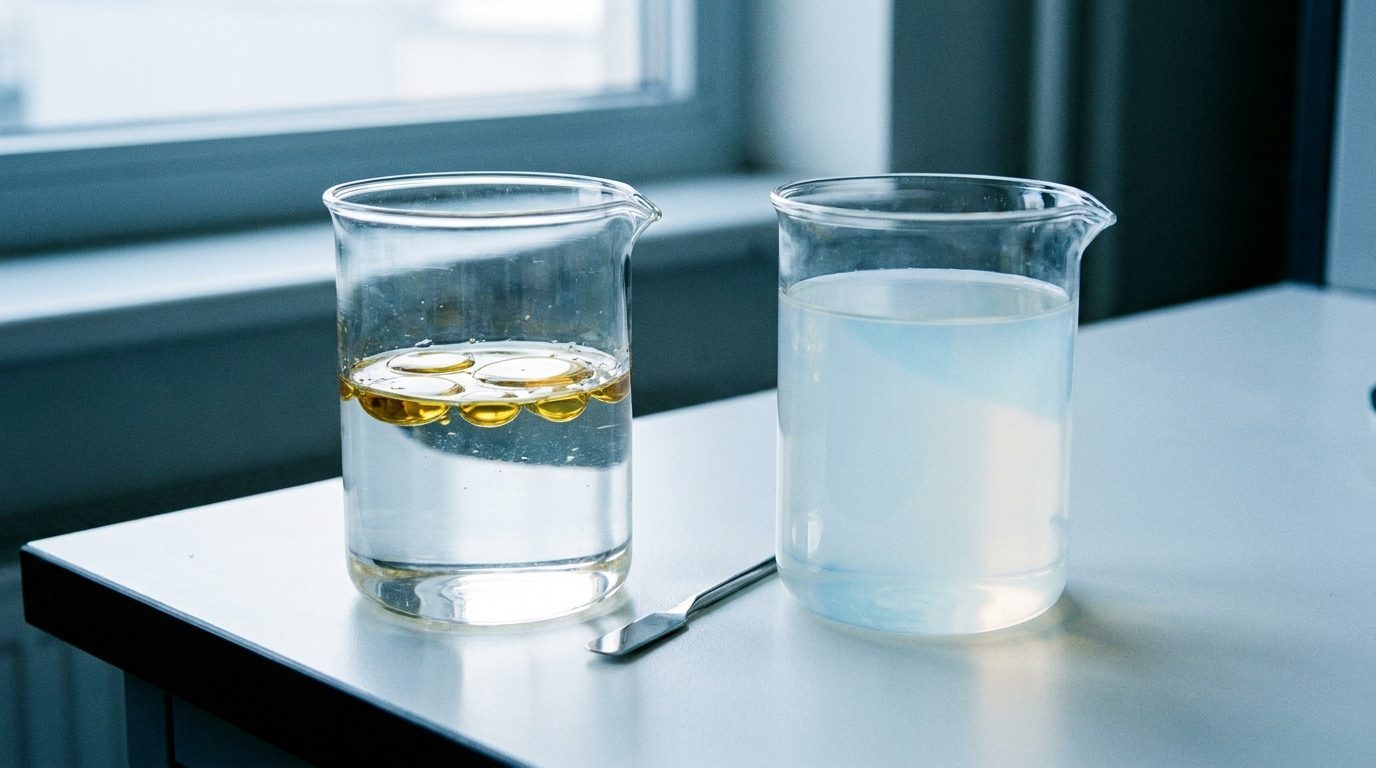
Oil and water do not mix on their own. Every water-soluble CBD product on the market contains at least one ingredient whose entire job is to force them together — and that ingredient usually gets far less scrutiny than the cannabinoid does.
Why an emulsifier is non-negotiable
CBD is a lipophilic molecule. Left alone in water it will not dissolve; it will cluster with other CBD molecules or with whatever oil it came in, and float, sink or stick to the container. An emulsifier — more precisely a surfactant — is a molecule built with two incompatible ends: a water-loving head and an oil-loving tail. Placed at the boundary between an oil droplet and the surrounding water, it lines up with its tail in the oil and its head in the water, lowering the interfacial tension so the droplet can be broken smaller and then kept from recombining.
This is the whole trick behind nanoemulsions. High-pressure homogenization or ultrasonic processing supplies the energy to shatter oil into tiny droplets; the surfactant supplies the stability that stops them merging back within minutes. Liposomal systems use the same principle with phospholipids that self-assemble into bilayer shells. No surfactant, no water-soluble CBD.
The main emulsifier families you will encounter
Formulators choose from a fairly small set of food-grade options, and the choice visibly shapes the finished product.
| Family | Origin | Typical behaviour |
|---|---|---|
| Polysorbates | Synthetic, from sorbitol and fatty acids | Very efficient; produce small droplets and visually clear beverages |
| Lecithins | Sunflower, soy, egg | Phospholipids; used for liposomes and emulsions; often cloudier |
| Quillaja saponins | Soap bark tree | Natural surfactant; effective at low levels; strongly foaming |
| Gum acacia and modified starch | Tree gum, treated starch | Polymeric; favoured for spray-dried powders; larger droplets, cloudy |
| Sucrose esters, mono- and diglycerides | Sugar and fatty acids | Familiar food emulsifiers spanning a range of properties |
Powders and beverages tend to diverge here. A dry powder needs a wall material that survives drying and rehydrates on contact with liquid, which favours gums and starches. A ready-to-drink beverage that is supposed to look like sparkling water needs droplets small enough to stop scattering light, which pushes toward the more efficient synthetic surfactants.
What HLB means and why formulators keep mentioning it
HLB stands for hydrophilic–lipophilic balance, a numerical scale describing how water-loving or oil-loving a surfactant is. Low numbers favour water-in-oil systems; high numbers favour oil-in-water systems, which is what water-soluble CBD needs. Matching the surfactant's HLB to the oil being emulsified is a large part of why one formulation stays clear for a year and another separates in a warm warehouse.
Blends are common. Two surfactants with different HLB values often stabilize a droplet better than either alone, because they pack more tightly at the interface. This is one reason an ingredient list may show several emulsifiers rather than one.
How much is in there, and why the amount matters
Type gets the attention; quantity often matters more. Making very small droplets requires a high ratio of surfactant to oil — in some clear beverage systems, considerably more surfactant by weight than actual cannabinoid. That has downstream consequences worth knowing about:
- Flavour. Many surfactants are bitter, soapy or astringent at the levels needed for clarity, which is part of why so many water-soluble products are sweetened or flavoured.
- Foaming. Saponins in particular foam vigorously. A powder that turns your glass into a head of froth is behaving normally.
- Digestive tolerance. Surfactants are food ingredients with established use, but some people report gastrointestinal upset at higher intakes, and that response is easy to misattribute to the cannabinoid.
- Dilution behaviour. An emulsion is stabilized at a particular concentration. Diluting it heavily, or dropping it into a drink with unusual salt, acid or alcohol content, can push it out of its stable range and cause visible separation or ringing at the surface.
How to find them on a Canadian product
Cannabis products sold through the legal system carry an ingredient declaration, and emulsifiers must appear there. Read past the cannabinoid content panel; the surfactant is in the ingredient list alongside water, sweeteners, acidulants and preservatives. Certificates of analysis will not help you here — they report cannabinoid potency and contaminant testing, not formulation composition. If a listing is vague and the ingredients are not published, that is a reasonable question to put to the licence holder's customer service before buying.
Be sceptical of language suggesting a product is emulsifier-free while also being water-compatible. Cyclodextrin complexes are a genuine alternative approach, but they are a different technology with their own carrier, not an absence of one. Something is always doing the work of carrying a lipophilic molecule into water.
Putting it to use
The practical move is simple: read the ingredient list the same way you would read one on a beverage you drink daily, because that is what these are. If you already avoid a particular emulsifier in food, avoid it here. If a product foams, tastes soapy or leaves a persistent aftertaste, the surfactant load is a more likely explanation than the cannabinoid, and a different formulation family — a lecithin-based or gum-based product rather than a crystal-clear beverage concentrate — may suit you better. You can explore more of the formulation background in our other articles. This page is general information about food and beverage ingredients, not medical advice.